Tackle it Tuesday: Grooming

Welcome to Tackle It Tuesday, a social media series where an autistic employee at AAoM (yours truly) writes workplace (and now more!) tips to better cope with the stresses of a world not built for neurodiversity.


This Tackle it Tuesday is on internet safety. Like the previous series of entries, this is a big topic, so I’m going to focus on grooming. This was my most difficult subject to date, and required a lot of research on top of my personal experience. After all, autistic people are especially susceptible to manipulation from bad actors, and there are pieces of etiquette that are unspoken to make internet interactions better.
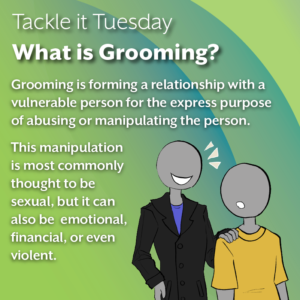
An image on a green background. On the bottom right, there is a person in a black coat leading away the shorter person in the yellow shirt. The text reads: "Tackle it Tuesday: What is Grooming? Grooming is forming a relationship with a vulnerable person for the express purpose of abusing or manipulating the person. This manipulation is most commonly thought to be sexual, but it can also be emotional, financial, or even violent. "

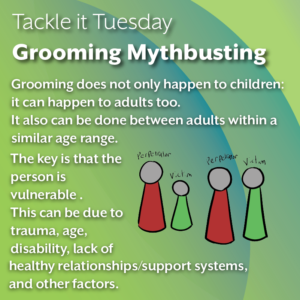
An image on a green background. On the right of the image is two illustrations, both representing a victim and a perpetrator. The image on the leftmost part of the image represents a perpetrator and a child victim. The image on the rightmost part of the image represents a perpetrators and an adult victim. The text reads: "Tackle it Tuesday: Grooming Mythbusting Grooming does not only happen to children: it can happen to adults too. It also can be done between adults within a similar age range. The key is that the person is vulnerable . This can be due to trauma, age, disability, lack of healthy relationships/support systems, and other factors."

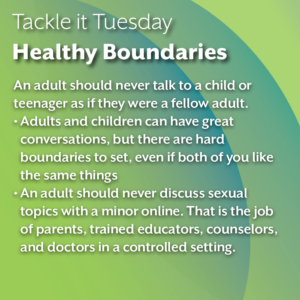
An image on a green background. The text reads: "Tackle it Tuesday: Healthy Boundaries An adult should never talk to a child or teenager as if they were a fellow adult. Adults and children can have great conversations, but there are hard boundaries to set, even if both of you like the same things An adult should never discuss sexual topics with a minor online. That is the job of parents, trained educators, counselors, and doctors in a controlled setting.

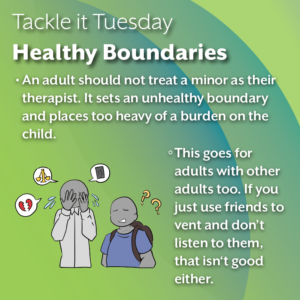
An image on a green background. On the bottom left, there is an adult crying about work, court cases, and relationships (represented by graphics such as a skyscraper, a golden scale, and a broken heart respectively) while a kid with a backpack looks on in confusion. The text reads: "Tackle it Tuesday: Healthy Boundaries An adult should not treat a minor as their therapist. It sets an unhealthy boundary and places too heavy of a burden on the child. This goes for adults with other adults too. If you just use friends to vent and don’t listen to them, that isn‘t good either.

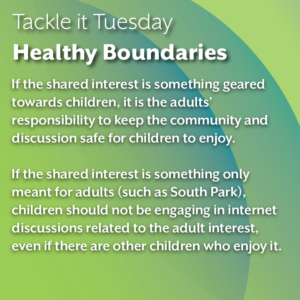
An image on a green background. The text reads: "Tackle it Tuesday: Healthy Boundaries If the shared interest is something geared towards children, it is the adults’ responsibility to keep the community and discussion safe for children to enjoy. If the shared interest is something only meant for adults (such as South Park), children should not be engaging in internet discussions related to the adult interest, even if there are other children who enjoy it. "

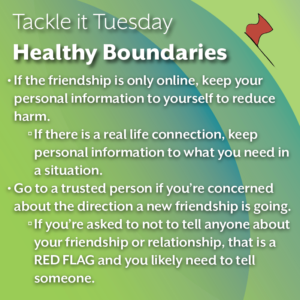
An image on a green background. A little red flag is on the top right corner. The text reads: "Tackle it Tuesday: Healthy Boundaries If the friendship is only online, keep your personal information to yourself to reduce harm. If there is a real life connection, keep personal information to what you need in a situation. Go to a trusted person if you’re concerned about the direction a new friendship is going. If you’re asked to not to tell anyone about your friendship or relationship, that is a RED FLAG and you likely need to tell someone."

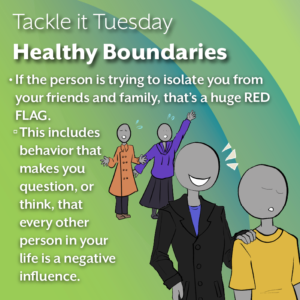
An image on a green background. On the bottom right, there is that same person in a black coat leading away the shorter person in the yellow shirt. Behind is other figures in coats calling out to the person in the yellow shirt, which can be interpreted as family, friends, or other loved ones. The text reads: "Tackle it Tuesday: Healthy Boundaries If the person is trying to isolate you from your friends and family, that’s a huge RED FLAG. This includes behavior that makes you question, or think, that every other person in your life is a negative influence."

RECENT ARTICLES

PAST ARTICLES

Leave a Reply

Your email address will not be published. Required fields are marked *